The hat game
The main objective of this activity is to engage students in the process of considering their own extra-rational responses to objects, as well as the extra-rational responses of others – to notice the similarities and differences, and critically engage with the reasons why this might be in a playful, collaborative way. This should provide a parallel to the presentation of objects (costumes, props, set pieces) which occurs in the staging of a live performance, and the predictability/unpredictability of what it is the audience brings into the room, and consequently how they will read and respond to the (costume) design. Secondly, it is to inspire them to experiment with alternative stimuli in the performance making process, adding to their creative toolkit.
- The participants are asked to silently engage with the objects presented to them in whichever way feels intuitive to them, within a set time (30 seconds or 1 minute each depending on student/object numbers).
- They are the asked to secretly write down one word in response to each object.
- They fold these up and place them in the hat.
- They are split into teams.
- In 1 minute intervals, each team has to guess the word pulled out of the hat by a single nominated ‘performer’, who must not use the word in the hat but may use any other words, or physical actions.
- This continues until all of the words have been guessed. The team with the most guesses ‘wins’.
- The words are laid out to look at and discuss, along with some prompt questions like ‘which words were the most difficult to guess/explain, and why do you think this is?’, ‘did you find any of the words surprising, and why?’.
The antiques roadshow
The main objective of this activity is to facilitate imaginative, collaborative enquiry and response to the objects. The hope is to utilise the framework laid out by Willcocks in a way which may engage performance design students more readily than quiet contemplation.
- In small groups, participants are given an ‘antique’ piece of costume, and only given information about the current owner and where they bought or found it, in the style of the antiques roadshow.
- Within a given time, the groups have to work together as a team of ‘antiques experts’ to surmise details and projected ‘values’ of the object. They do this using a prompt sheet of questions which will include; ‘Who do you think made this object? Where do you think it was made? What is its ‘value’?’.
- Each group has to deliver their findings, in the style of the antiques roadshow, to the rest of the group as though it were the television programme – in this way, they are encouraged to state things about it sensorially (smell, temperature, surface feel, weight etc). There is potential here for me, or an enthusiastic volunteer, to pretend to be the owner of the antique, or the shows presenter, Fiona Bruce.
n.b. the setup of this could include the use of white gloves/costume pieces/alias in order to amp up the roleplay element.
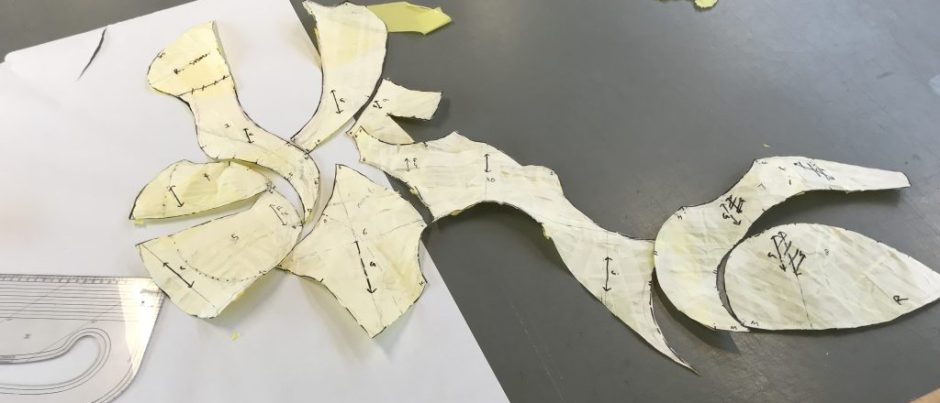
Abstract pattern cutting
Mini version of what I teach on a larger scale – participants wrap a small object up in cling film, then masking tape. They then draw lines on them over the ‘highest’ points and are show how balance marks work. They then chop the paper off, and try to lay the piece flat.
Materials bingo
Participants are presented with numbered, unnamed raw materials, and individually, or in groups they have to guess which ones has been used in the items (s). With enough items and materials, a bingo card can be filled, and the actual materials revealed (or not?!).
The design pitch
In small groups, participants have to make up the details of an object as though they jointly designed it for a specific purpose/show, which are written down, or alternatively they are interviewed as such with questions like ‘why did you choose this material?